Houses for Rent With a Back House: Why the ADU Out Back Is Your Best Airbnb
Your back house is currently storing a treadmill, four totes of Christmas decorations, and a bike your brother-in-law has been "coming back for" since roughly two presidents ago. It's a Saturday morning in October, the Cyclones are home, every hotel room on Duff is booked and priced like it briefly relocated to Manhattan, and you're out in the yard digging for a leaf rake inside a fully plumbed building with its own front door, its own bathroom, and its own driveway. Meanwhile people are typing "houses for rent with a back house" into a search bar tonight. And you're using yours as the world's most expensive shed.
The operator's take, after five years and 60-plus short-term rentals across Central Iowa: a back house — guest house, casita, garage apartment, ADU, whatever your county calls it — is one of the best short-term rental assets a normal homeowner can own. Not because it's big. Because it's separate. Separate is the whole product. Separate is what guests pay for.
What a back house actually is — and why guests fight over them
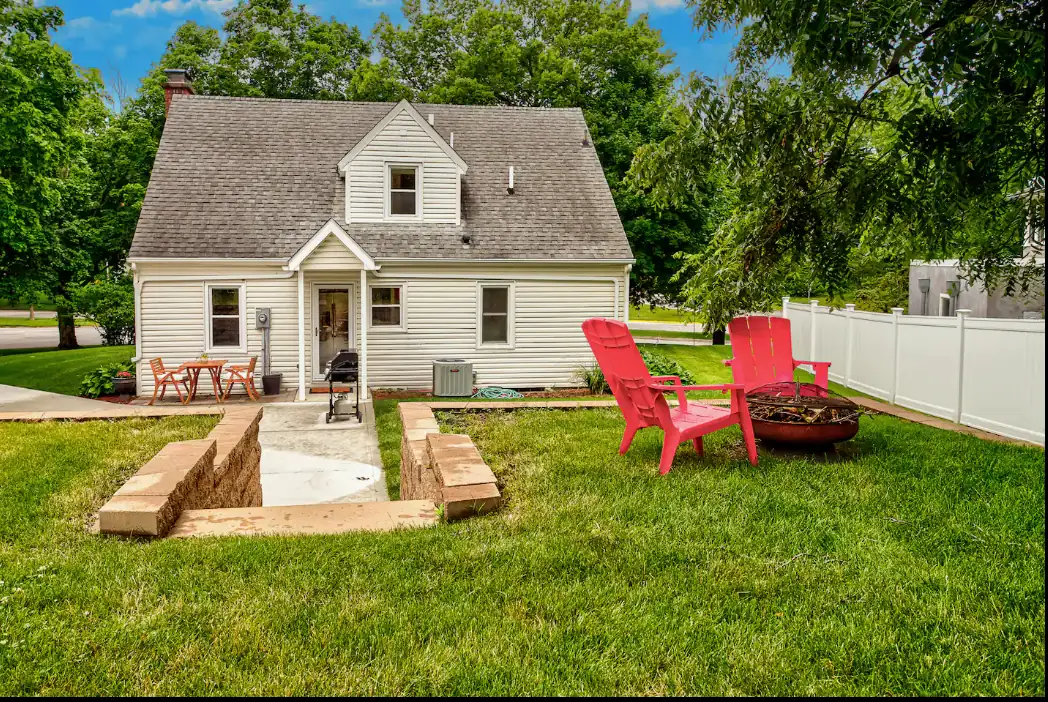
A back house is a second, self-contained living space on a lot that already has a main home. Detached out back, above the garage, tucked behind the fence. The industry term is ADU — accessory dwelling unit — the least charming name ever assigned to something people genuinely love.
What makes it work isn't square footage. It's the walk from the car to the door without passing through anybody's kitchen.
Guests who book a back house are usually solving for privacy. A hotel gives them a hallway, a stranger's TV through the wall, and a parking garage. A spare bedroom in someone's house gives them an awkward 6am negotiation over the coffee maker. A back house gives them a front door, a key, and the ability to exist without performing politeness. That's a real gap in the market, and it's why listings with separate entrances tend to punch above their size.
Nobody has ever left a five-star review that said "loved sharing the entryway with the owner." They review the coffee, the bed, and the fact that nobody knew when they came home. Privacy doesn't show up in the photos, but it shows up in the ratings.
The house-hack: live in front, rent the back
This is the version that gets owners' attention. You keep living in the main house. The back house goes on Airbnb and VRBO. Same lot, same lawn you were already mowing — one of the two buildings now has a job.
We manage duplexes that run this way and they work well, including hybrids where one side runs short-term and the other stays long-term. A back house is the same idea with better boundaries and a fence.
The advantages stack up fast. You're on-site, so you notice the sagging gutter. No second mortgage, no drive across town when a smoke detector starts chirping. The space already exists — most owners are just paying to heat it for storage.
The honest downside: guests are now roughly forty feet from where you eat dinner. If strangers pulling in on a Friday night makes your shoulders climb, this isn't your play, and that's a legitimate answer. If it doesn't bother you, a back house is about as low-friction as short-term rental gets. We broke down the earning math in our piece on whether Airbnb is actually profitable.
What makes a back house guest-ready
Having the building is step one. Making it bookable is a different project — and the gap between "we could rent that" and "guests would five-star that" is where owners underestimate the work. A back house is genuinely guest-ready when it has:
- A private entrance guests can find in the dark. Their own door, their own path, lit. If the route involves your side yard, a gate latch with a technique, and a motion light that hates everyone — fix that first.
- Its own parking spot. Not "there's usually room on the street." A specific, named place to put the car. Parking confusion is a reliable way to start a stay badly.
- Real sound separation. Both directions. They shouldn't hear your dog at 6am; you shouldn't hear their group chat at midnight.
- A functioning kitchen — even a small one. Fridge, sink, a real cooktop, and enough dishes that two people aren't taking turns. Kitchenette is fine. Microwave-on-a-dresser is not.
- A full private bathroom. Non-negotiable. Shared-bath ADUs are a different, much lower-rate product.
- Heat and air guests control themselves. Their own thermostat, or you're getting texts about it. Guaranteed.
- Wi-Fi that works out there. The router in your living room does not reach the back house. It never has.
- Working detectors and clear exits. Smoke, CO, extinguisher, a way out. Boring, and the only genuinely mandatory part.
- Storage that isn't your storage. If a guest opens the closet and finds your Christmas totes, they know exactly what this place is. Move the treadmill.
None of that is exotic. All of it is the difference between a listing that fills on its own and one that gets a polite 4.2★ and a note about the parking.
Now the homework: what your city allows
This is the part where I have to be useful instead of fun.
Whether you can legally rent a back house short-term varies enormously — city to city, sometimes neighborhood to neighborhood. Some places treat an ADU as a normal rental. Some allow it long-term but not nightly. Some require the owner to live on-site, which the house-hack setup happens to satisfy. Some want a permit, a registration, an inspection, lodging tax remittance, or all four. Ames, Des Moines, and Ankeny are three different conversations, and the rules move.
So don't take a blog's word for it. Mine included.
Call your city before you buy a single throw pillow
Ask the planning or zoning department three things: is short-term rental permitted for an accessory dwelling unit at my address, what permit or registration do I need, and are there lodging taxes I have to collect? Get it from the people who enforce it, not from a forum. Fifteen minutes on the phone beats a violation letter. We keep a plain-English overview in our post on short-term rental regulations in Central Iowa — start there, then confirm with your city.
Who books a back house in Central Iowa
The demand here is not theoretical, and it isn't all game weekends — though the game weekends are loud.
ISU brings parents, alumni, and recruiting visits into Ames on a schedule you can see coming twelve months out. When the Cyclones are home, every spare room in town suddenly remembers it has a price — and a private back house with its own driveway is an easier sell than a hotel forty minutes out.
Then there's the steadier stuff. Traveling nurses working Des Moines and Ames hospitals want a month, a kitchen, and a door that locks; a back house is nearly purpose-built for them. Consultants and project crews around Des Moines and Ankeny book weeks at a time. Families in town for a graduation or a funeral want to be near people without being in the guest room.
That mix is the quiet advantage. A back house isn't hostage to one football calendar — it can flex between nightly, weekly, and monthly guests as demand shifts, which is what keeps a small space earning in a slow February. Same playbook we walk through in how to rent out a house, just on a tighter footprint.
The part that never ends
Everything above is a project with a finish line. Furnish it, photograph it, list it, done.
Operations are the part that doesn't stop. Pricing that moves with the ISU calendar instead of sitting flat through a home game. Guest messages answered in minutes, not after dinner. Turnovers between an 11am checkout and a 4pm check-in whether or not you had plans. Compliance renewals. The odd 4.2★ review that needs a human response.
Owners want the back house income. Almost nobody wants the Sunday-morning towel emergency in their own backyard. That gap is the entire reason we exist.
If your back house is earning nothing but storage fees from your own family, let's talk about what it could actually do. Tell us about the property and we'll put together a free estimate — just an honest read on whether it's worth listing. You own it; we run it.
Houses for Rent With a Back House: FAQ
What is a back house?
A back house is a second, self-contained living space on a lot that already has a main home — detached out back, above the garage, or tucked behind a fence. The formal term is an ADU, or accessory dwelling unit. What separates it from a spare bedroom is that it functions as its own home: a private entrance, its own bathroom, and usually a kitchen, so a guest can come and go without ever passing through the main house.
Can you rent out a back house on Airbnb?
In many places, yes — but it depends entirely on where you are. Rules for renting an ADU short-term vary a lot from city to city, and sometimes by neighborhood. Some cities treat it as a normal rental, some allow long-term stays but not nightly ones, and some require a permit, registration, an inspection, or lodging tax collection. Call your city's planning or zoning department and ask about your specific address before you list anything.
What makes a back house guest-ready?
Six things do most of the work: a private, well-lit entrance guests can find in the dark; a dedicated parking spot rather than street parking they have to hunt for; real sound separation in both directions; a functioning kitchen, even a small one; a full private bathroom; and heat and air the guest controls themselves. Add Wi-Fi that actually reaches the back of the lot and working smoke and CO detectors, and you have a listing that competes.
Can I live in the front house and rent out the back house?
That's the house-hack version, and it's a common setup. You keep living in the main home while the back house takes guests — same lot, one building with a job. The advantages are real: you're on-site to catch problems early, and there's no drive across town when something breaks. The trade-off is that guests are close to your daily life, so it comes down to how you feel about strangers pulling in on a Friday night. Some cities also require an on-site owner for ADU rentals, which this setup happens to satisfy.